Sunday, 21 July 2024

Olympus OM-10 Test Film


Embracing imperfection. 


At the beginning of this year (2024) I got given a Olympus OM-10 35mm camera, along with some filters and other bits. Which I am very great-full for. However there was a chance that the camera did not work. 
So I  put battery's in it, which came out of my working OM-10 and grabbed a 24 exposure Kodak Gold and shot the film on my why in to work.
And unforchantly the camera did  not work. The advance leaver would jam and the shut would not compleat its movement, but I persevered and finished the film. 
I wasn't expecting anything great, apart from a load of blurry over exposed frames, so I was pleasantly surprised to get at least half a roll of photos.
Even though most of them are a little blurry and over exposed, there is something that about them that I like.

Abandoned Train Bridge

Regents Canal.

Regents Canal II. 

Side Street Art.

Doc Martins Painting

Boarded Up And Abandoned Apartments.

Boarded Up Apartment Art.

School Wall Art.

Art On School Gates.

Boarded Up Apartment Building Art

Cross Roads Under Abandoned  Bridge.

This is the best photo there is and currently one of my favourite photos I’ve taken.  

My Desk Full Of Plants.

I have taken the camera to a couple of place to see if I could get it fixed, one place said it was the battery's and another wanted £300+ to fix it. So for now its sitting in my book case looking pretty.


Find more of my photos over at instagram: @ALostPhotoBook.


Tuesday, 3 May 2022

Olympus OM-10 Film 001


Camera: Olympus OM-10

Film: Fuji Neopan 400CN

ASA/ISO 400

Development: C-41 film processor

Date: Monday 25th April 2022

Location: Alexandra Palace boating Lake.

Saturday, 5 March 2022

Dubblefilm Pacific. Bolsey Film 10.

Thoughts On Film.


Dubblefilm is a film company based in Spain and was set up in 2017. They produce 35mm film that is inspired by popular mobile apps,  filters and effects which they have applying to film.

The Pacific film adds tones of green and blue hues to the images. However depending on shooting conditions  results will vary. The film comes as 36 exposure and in 24 exposure.

I Brought my roll from the Photographers Gallery in London at the end of 2019 and it sat in my fridge until November 2020 when I used it in my  Bolsey Jubillee camera and was set at 200 ISO.


It was shot over the cause of three days, so the conditions were different through out the use of the film. 


I found that the film gave the images a warm yellow, orange to red tones on most of them, (images 1, 2, 3, 4, 5, 6.) some of them that were shot in brighter light lost the strong tones and seamed as though they had been short with a Kodak Gold film.(images 7, 8.)

The effect gives a very old vintage look, the sought of effect you get when you shot and process an out of date film that has been stored in an controlled environment.


 Image 1. 

Image 2.

Image 3.

Image 4.

Image 5.

Image 6.

Image 7.

Image 8.

On some of the photos I done auto colour on them, which took away the orange. yellow tones and gave the images a green tone making them quite cold. It also makes the reds stand out more (images 3A and 9), as well as giving the illusion of bring the image more into foucs, giving it more depth.
It also throughs of the white balence a little making the white areas a blue, green tone. (image 9 ).

Image 1A

Image 2A

Image 5A

Image 3A

Image 9

This is a strange film, and I not a huge fan. A lot of the photos I have seen on line for his film always seam a lot more less saturated with the yellow, orange and red tones, weather the image is taken i low light or bright light. 
I was not completely sure what I was expecting with this film as it dose fall in the group of experimental film in my mind.  And its not a film that I will try again unfortunately.


Images 1, 2, 3, 4, and 9 taken in camden.
Image 5, 6, 7, and 8 taken at Alexandra palace.
More photos from: Bolsay Jubillee 
More photos from: Bolsey Film 010,
More photos from: Camden
More photos from: Alexandra Palace.

Saturday, 7 August 2021

Holga Film 004: Through Windows.

I wanted to see how much of a difference the two settings on the Holga Camera gave. Using a 3200asa film you don't get that much of a difference. Or at least I didn't seam to.


Cloudy setting

Sunny Setting


Camera: Hoga 120
Film Mask Size:  6x6cm
Film: Ilford Delta 3200
ASA/ISO:3200
Development: True Black & White. 11 Min in Rodial, 1:25 mix
Editing: None
Date: April 2020


Friday, 6 August 2021

Bolsey Jubillee Film 005: Empty Chairs.

I was trying to capture some strong shadows with these two. the first one sought of worked the second one not so much. I like the shadows that the wicker chair is casting on to the wall from the arm of the chair. wish I had noticed this more before taking the shot, as I wound have played with the position of the chair.

I did turn both of these photos in to black and white images - they are at the bottom for the post, hoping that it would make me like them more, but there is still something note wright.
(At some point I will have to download Photoshop or light room so I can edit photos better.)
Both of these photos were taken on the Sunday 22nd of March 2020, the before the country was placed in lockdown due to Covid-19.


Camera: Bolsey Jubillee
Film: Fujifilm Superia 400 X-Tra
ASA/ISO: 400 Set at 200 ASA/ISO
Development: C-41
Editing: None (unless noted below image.)
Date Taken: Film shot on Sunday 22nd March 2020


Monday, 8 March 2021

Holga Film 004: Stairs

Camera: Holga 120

Film Mask Size: 6 x 6cm

Film: Ilford Delta 3200

ASA/ISO: 3200

Development: True Black & White. 11min in Rodana 1:25 mix

Editing: None

Date: April 2020 

Sunday, 7 March 2021

Holga Film 00: Kitchen.


Camera: Holga 120

Film Mask Size: 6 x 6cm

Film: Ilford XP2

ASA/ISO: 400

Development: True Black & White. 18 min in Rodania 1:25 mix

Editing: Quite a lot of dust removal in Photoshop

Date: April 2020


Saturday, 6 March 2021

Holga Film 003: Desk.


Camera: Holga 120

Film Mask Size: 6 x 6cm

Film: Ilford XP2

ASA/ISO 400

Development: True Black & White. 18 min in Rodania 1:25 mix

Editing: Quite a lot. Dust removal in Photoshop and contrast increased slightly.

Date:  April 2020


Friday, 5 March 2021

Foma Retropan Soft 320 Black & White Film. Olympus Trip Film 22

Foma Retropan Soft 320 black and White film is a panchromatically* sensitized special negative black and white film with fine grain, good resolution and contour sharpness. The film is characterised by a wide range of half tones and soft light which makes it suitable for photography and subsequent contact printing or “retro” style enlarging of negatives (photographs of still lives, architecture, experiments, landscapes, portraits, etc.).


This film is available in 35mm and 120mm formats as well as different sizes of photographic papers.

I Brought a 35mm  roll of this film from the Lomography shop on Newbourgh Street In Soho London (which is now closed) back in 2017 and it sat in my fridge until last November (2019) when I picked up another roll from the Photographers  Gallery on Ramillies Street, Soho, London, at the same time I picked up the  development powder kit which is recommend to use with this film as it is a soft grain. Prior to this my plan was to process it in Rodinal but the thought of spending every 30seconds moving the tank of 10 seconds for 20mins seemed a little dull. Whereas the Retropan developer reduced the time to only 4-5 minutes.


The Developer is a power developer that comes in two parts. One small pack and a large pack. (I did keep the packs form them but I currently cannot find them, they are in that safe place where I would not forget were that are).

  • First you will need 700ml of water at 40C.
  • Add the smaller pack to the water, stir till dissolved
  • Then add the larger pack and stir till dissolved
  • Then add 300ml of water to the solution to make it the full 1 litre working solution.
  • Leave to cool till it is at 20C (or run sealed bottle under tap, checking the temperature intermittently)
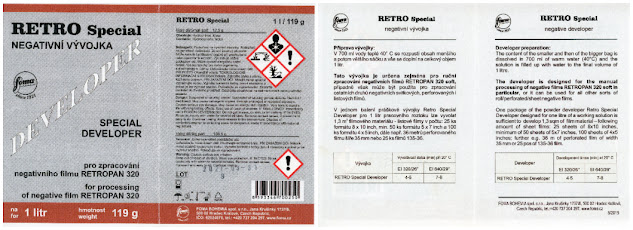
 

I found that the tank I use once it has film in holds an estimated 850ml of solution leaving just enough room for me to then agitate the film using the spindle to rotate the film without risking making a mess each time. Each film was developed for 5 minuets in the developer and 4 minuets in ilford fix.

Both rolls of film were shot with my Olympus trip 35, set at the box speed of 320 ISO on the Auto setting. Which is a little lazy but when I’m shooting a new film for the first time using this camera this why increasing the chances of seeing the full potential of the films results.

Film #021

Film #021

Film #022

Film #022

This film creates a soft sharp of depth, which I have only managed with some frames with the Ilford Delta's. 

I do love black and photos that have a lot of contrast so with some of the images I could not resist putting them in to photoshop and doing auto contrast. I not one for editing the colours on photos at most in the past I have only straighten images. Every now and then I might edit some.
Film #022. "Camden Tube" Image on the left is the original scanned photo. On the right is the photoshopped image with auto contrast.

Film #021."Hanging Plants" Image on the left is the original scanned photo. On the right is the photoshopped image with auto contrast.

Film #022. "Plants" The top image is the original scanned photo. The below image is the photoshopped image with auto contrast.


Changing the contrast on this film means losing the some of the details and depth, which you can see in the "Camden Tube" image above. however with the "Plants" it has made the image clearer.
The almost creates a vintage movie still look.

I think I need to get another roll and see what the result will be when developed in Rodinal, see if it keeps its softness or weather it becomes more contrasty. 

        *A panchromatic emulsion produces a realistic reproduction of a scene as it appears to the human eye, although with no colours. Almost all modern photographic film is panchromatic.